
Оценка биоудобрений и водного режима на всхожесть томатов (Solanum lycopersicum L.).
Оценка биоудобрений и водного режима на всхожесть томатов (Solanum lycopersicum L.).

Аннотация
В настоящем исследовании изучалось влияние чая из биогумуса, Никфана и воды на выведение семян томатов из состояния покоя (Solanum lycopersicum L.). Испытания проводились в течение двух лет (2025 и 2026). Семена томатов сорта F1Cemko 30 были подвергнуты трем 24-часовым обработкам при температуре 24 градуса перед посевом на глубину 1 см. Органический гумусовый чай (1 мл органического гумусового чая на 1 литр воды), Никфан (1 мл Никфана на 1 литр воды) и водопроводная вода были использованными растворами, а контрольная обработка не проводилась. Эксперимент проводился в теплице Белгородского государственного аграрного университета имени В. Горина. Наши результаты показали, что у обоих биоудобрений была самая высокая всхожесть, превышающая 93%, при самой низкой скорости прорастания, которая составляла около 5 дней, после чего следовали предварительные обработки водой, которые демонстрировали скорость прорастания около 6 дней при скорости прорастания 88,89%. При самой низкой скорости прорастания. Первый год по сравнению с 91.11% на второй год. Семена, не замоченные в жидкости, показали самую низкую всхожесть (60% в 2025 году и 71,11% в 2026 году) при скорости прорастания около 8 дней. Используемая вода и биоудобрения действовали как биологический катализатор, что способствовало быстрому выходу из состояния покоя и однородному появлению всходов.
1. Introduction
Agriculture is an activity that contributes significantly to the socio-economic development of the population
, . Within this sector, we find vegetable crops mainly focused on the production of vegetables, in particular tomatoes. The consumption of this fruit vegetable contributes to the food and nutritional security of populations through their use in various dishes . Regular consumption of tomato or tomato-based products reduces the risks of cancers, but also cardiovascular diseases, diabetes and osteoporosis , . Due to climate change and the instability of food security, it is essential to improve our ways of growing this fruit vegetable. However, to produce healthy, uniform and productive tomato plants, it is important to successfully germinate the seeds. This germination phase is crucial and determines the tolerance or sensitivity of the plant . To solve this problem, several techniques have emerged, in particular genetic and biotechnological techniques which consist in modifying and transferring resistance and rapid growth genes. However, these techniques remain very expensive and inaccessible to small farmers. It is therefore important to find simple, effective, less expensive agro-ecological alternatives. The present work aims to determine the effects of different solutions (NIKFAN solution; bio humus tea) and water on improving the germination of tomato seeds (Lycopersicon esculentum).The experiment was conducted in the greenhouse at the Belgorod State Agrarian University named after V. Gorin. The geographical coordinates of the site are 50°51'27.33" north latitude and 36°45'69.67" east longitude.
1.1. Seed treatments
The tomato seeds of the F1Cemko 30 variety were subjected to three treatments for 24 hours with a temperature of 24 degrees before being sown to a depth of 1cm. Organic humus tea (1 ml of organic humus tea in 1 liter of water), Nikfan (1 ml of Nikfan in 1 liter of water) and tap water were used solutions and untreated control treatment. Each treatment had 15 seeds with three repetitions. The pretreated and untreated seeds were germinated in the dark and irrigated every morning with tap water. The experiments were carried out over two years from April 2025 to May 2025 and from March 2026 to April 2025.
In total other treatments that are:
T0: control treatment
Tn: treatment with the Nikfan solution
Tb: treatment with bio humus
Tw: treatment with water
1.2. Germination parameters
Germination was monitored every day. The appearance of the radicle with a length of 3 mm was considered lifting. The number of germinated seeds per day was counted for 28 days.
Data processing
Three parameters were analyzed namely the germination rate (GR) and the germination speed (GS).
1. The germination rate (GR) was calculated according to the formula . This rate makes it possible to determine the germination rate of the seeds. It is equal to the number of germinated seeds in relation to the total number of sown seeds. It is expressed as a percentage.
With N the number of seeds sown and n the number of seeds germinated.
2. Germination speed used by corresponds to:
With GS: germination speed, Gi: germination rate of the day i, Ji: number of days since sowing, GR: total germination rate.
1.3. Statistical analysis of data
All the data were entered in the Excel 2020 software then imported and processed using the PAST version 4.03 software. Two types of statistical analysis were performed: one-way ANOVA and two-way ANOVA (P˂0.05).
2. Results and discussion
The results obtained during the two years reveal a significant difference between the treatments (F=17.16, df=4.3, p=0.007 for the year 2025 and F=7.41, df= 4.3, p=0.03 for the year 2026). During the two years, we note that the seeds that stayed in a solution have a high germination rate compared to the control treatment in Figure 1. This would be explained by the phenomenon of dormancy lifting of the integumentary type explained by , , . These authors in their scientific research have proven the effect of the dormancy of the seeds when immersed in different solution.
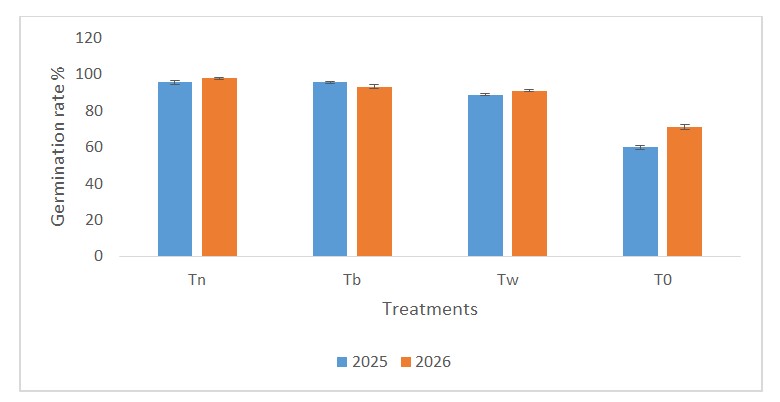
Germination rate of tomato seeds over two years
T0: control treatment, Tn: treatment with the Nikfan solution, Tb: treatment with bio humus, Tw: treatment with water
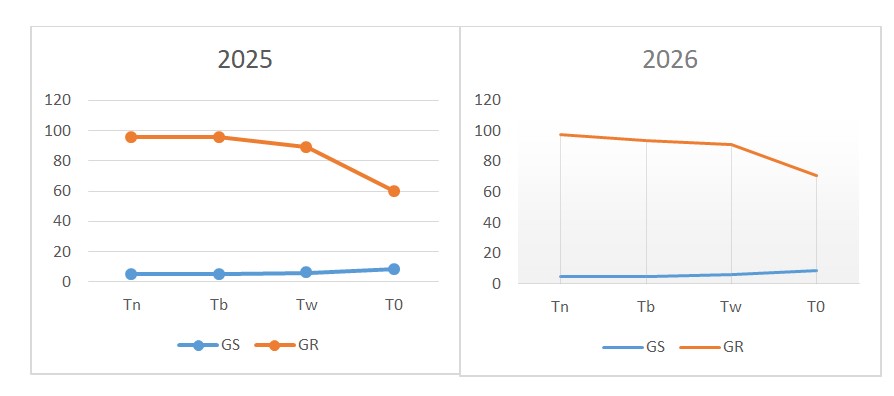
Relationship between the germination speed and the germination rate over two years
T0: control treatment, Tn: treatment with the Nikfan solution, Tb: treatment with bio humus, Tw: treatment with water, GS: germination speed, germination rate (GR)
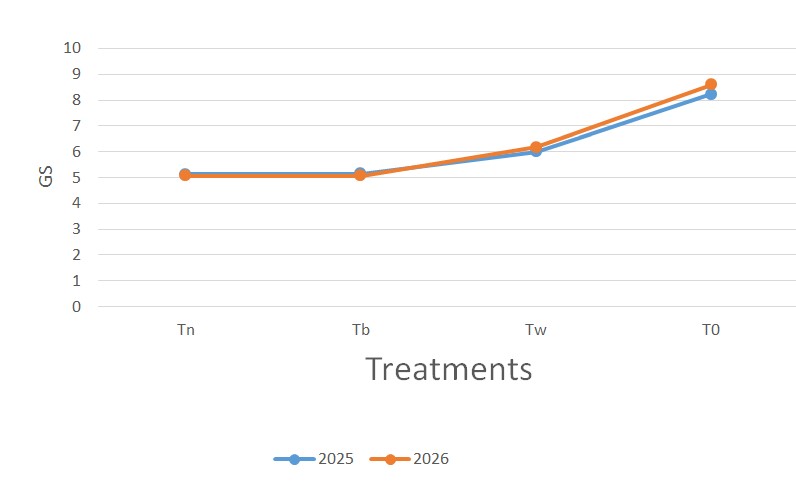
Germination rate during the two years
T0: control treatment, Tn: treatment with the Nikfan solution, Tb: treatment with bio humus, Tw: treatment with water
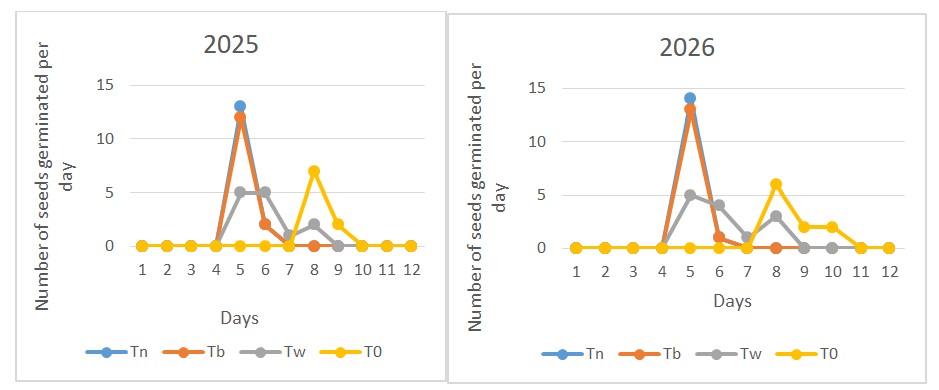
Evolution of germination over time
T0: control treatment, Tn: treatment with the Nikfan solution, Tb: treatment with bio humus, Tw: treatment with water
Also observed the emergence of soybeans when they had pretreated the seeds with vermicompost juice. The pre-germination treatment with water gave a germination rate of about 6 days for the two years of experience, a difference of two days less than the control treatment with a germination rate of 88.89% in 2025 against 91.11% in 2026. This observed germination rate could be explained by the action of water on the seed coats. The work of has also demonstrated the role of water in the softening of the integuments thus facilitating the exit of the radicles in tomatoes. Indeed , also confirms the role of water in softening the hard shell of seeds . Have found a moisturizing effect of the tissues of tomato grains soaked in water which undoubtedly activates the enzymes responsible for the digestion of nutrient reserves. The work demonstrated that prolonged pre-germination in water accelerates respiration, which has an effect on the activation of the Krebs cycle, glycolysis, protein synthesis as well as the hydrolysis of stored starch, thus leading to slower seed germination.
3. Conclusion
Finally, the pre-germination treatment with bio fertilizers (organic humus tea and Nikfan) and water improved the germination rate and the germination speed compared to untreated controls. The germination speed has increased from 5 days for grains pretreated with bio fertilizers to 6 days for grains treated with water compared to 8 days for untreated grains. The water and the bio fertilizers used acted as a biological catalyst, therefore inducing a rapid emergence from dormancy and a homogeneous emergence of seedlings. This inexpensive, simple and ecological method therefore makes it possible to reduce the use of chemical fertilizers while producing resistant, vigorous and homogeneous seedlings.